How Is the Climate Energy Hitting You? is a collection of backyard experiments conducted in conjunction with you—the reader. The goal is simple: to look at how the increased energy in the climate system is showing up in our everyday lives.
Is it becoming more extreme, more frequent, and more persistent? Are the changes becoming stranger—or even disturbing?
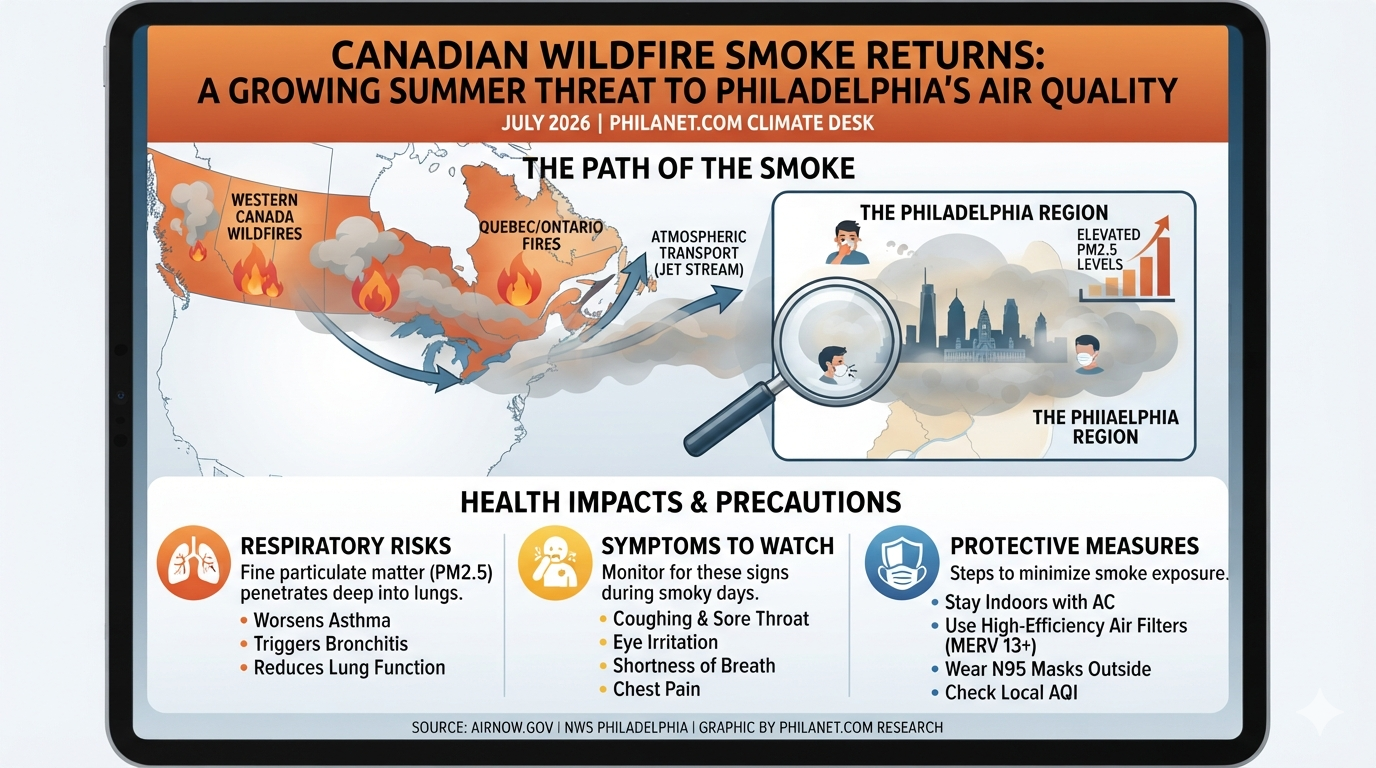
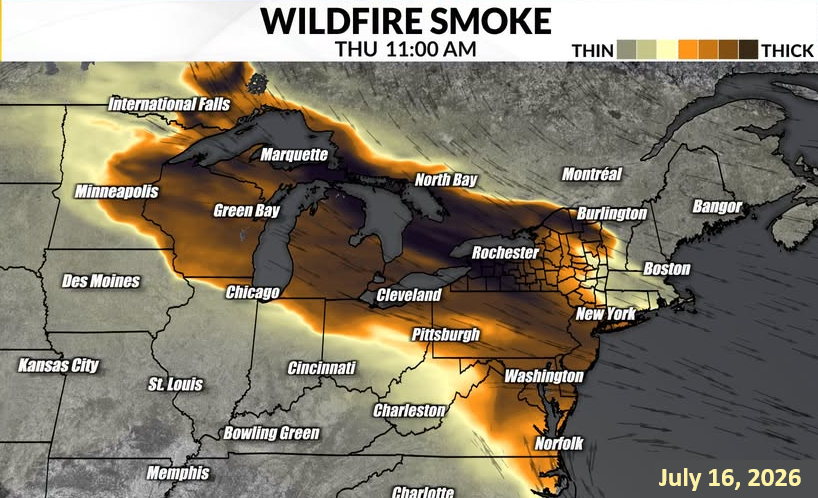
Canadian wildfire smoke is once again drifting into the Philadelphia region, bringing hazy skies, reduced visibility, and deteriorating air quality. Over the next 24 to 48 hours, meteorologists expect a thick plume of smoke to spread across the Delaware Valley as winds transport emissions from large wildfires burning across Canada.
The smoke arrives at the same time an intense near-record heat dome is pushing local temperatures toward 101°F, creating a dangerous combination of extreme heat and air pollution.
A Double Environmental Threat
According to the U.S. National Weather Service in Philadelphia/Mount Holly, smoke from Canadian wildfires is being carried across the Great Lakes and into the northeastern United States. While the smoke may remain high in the atmosphere at times, periods of surface-level smoke can significantly reduce air quality.
The simultaneous occurrence of extreme heat and wildfire smoke amplifies health risks, particularly for vulnerable populations including:
Children
Older adults
Pregnant women
People with asthma or COPD
Individuals with heart disease
Outdoor workers
Athletes exercising outdoors
Heat stresses the cardiovascular system, while fine smoke particles place additional strain on the lungs and heart.
Current Conditions and Forecast
Residents across southeastern Pennsylvania, New Jersey, and Delaware should expect:
Smoky, hazy skies with noticeably reduced visibility.
Dimmed sunlight, giving the sky a milky or orange appearance.
Extreme Heat Warnings, with heat indices between 100°F and 109°F.
Worsening air quality, as concentrations of fine particulate matter (PM2.5) increase.
Even when the sky does not appear especially smoky, microscopic particles can remain suspended in the air and pose health risks.
Why Wildfire Smoke Matters
Wildfire smoke contains a complex mixture of gases and microscopic particles. The greatest concern is PM2.5—particles smaller than 2.5 micrometers in diameter. These particles are small enough to bypass the body’s natural defenses and penetrate deep into the lungs, where they may enter the bloodstream.
Exposure to elevated PM2.5 has been linked to:
Asthma attacks
Reduced lung function
Eye, nose, and throat irritation
Heart attacks and strokes in susceptible individuals
Increased emergency room visits
Premature mortality during severe pollution episodes
Even healthy adults may experience coughing, sore throat, headaches, fatigue, or shortness of breath during periods of elevated smoke.
How to Protect Yourself
Because extreme heat and wildfire smoke are occurring simultaneously, taking precautions is especially important.
Stay indoors whenever possible. Keep windows and doors closed, particularly during the afternoon and evening when pollution levels often peak.
Use air conditioning. Operate your HVAC system on the recirculate setting to reduce the amount of outdoor air entering your home. A MERV 13 or higher filter can significantly improve indoor air quality.
Limit strenuous outdoor activity. Running, cycling, heavy yard work, and other vigorous exercise increase breathing rates, causing more smoke particles to be inhaled.
Monitor the Air Quality Index (AQI). Air quality conditions can change rapidly depending on wind direction and the movement of smoke plumes.
Consider wearing a properly fitted N95 respirator if you must spend extended periods outdoors during heavy smoke conditions. Cloth masks and surgical masks do not effectively filter PM2.5 particles.
A New Summer Reality
Canadian wildfire smoke has affected the eastern United States every summer since 2023, highlighting a growing environmental challenge. Warmer temperatures, prolonged droughts, and longer fire seasons have contributed to increasingly large and persistent wildfires across Canada.
As these fires become more frequent and more intense, smoke transport over thousands of miles is becoming an increasingly common feature of summers across the Northeast.
For residents of Philadelphia and much of the East Coast, hazy skies that were once considered unusual are now becoming part of the seasonal weather pattern.
Looking Ahead
While individual smoke events may last only a day or two, they illustrate a broader trend toward more frequent climate-related air quality disruptions. Preparing homes with effective air filtration, monitoring local air quality forecasts, and adjusting outdoor activities during smoke events are becoming practical components of summer health planning.
For now, Philadelphia residents should prepare for hot temperatures, smoky skies, and reduced air quality over the next several days and take appropriate precautions until the smoke plume moves out of the region.
Climate change is rapidly accelerating the frequency, severity, and financial impacts of extreme weather events, while sea-level rise is outpacing previous projections. Originally estimated at 100 years, the climate doubling period—the time it takes for climate impacts to double in intensity—contracted to 10 years, then to 2 years by 2024. This means damage from climate change today is already twice what it was just two years ago. If this trajectory continues, damages could be four times worse in two years, eight times worse in four years, and up to 64 times worse within a decade, driven by tipping points, feedback loops, and cascading ecosystem failures that further shorten the doubling period.
The Jersey Shore is a ground-zero case study of the rapidly oscillating and unsustainable costs of owning coastal real estate in the climate crisis era. Increasing insurance costs, surging property taxes, infrastructure collapse, and saltwater intrusion are eroding property values across New Jersey’s coastal communities.
Saltwater intrusion is contaminating freshwater drinking supplies and flooding sewer and water treatment systems, causing environmental and health hazards while requiring expensive upgrades that drive up local costs. After Hurricane Sandy, FEMA and federal flood insurance programs shifted to a managed retreat approach, permanently relocating many properties along the coast. Now, many homeowners are finding insurance premiums skyrocketing or coverage becoming unavailable entirely, leaving them financially exposed to inevitable future storms.
Meanwhile, property taxes are rising steeply as municipalities struggle to fund repairs and upgrades to stormwater management systems, roads, bridges, and sewage treatment facilities damaged repeatedly by floods and storm surges. Communities are left with a shrinking tax base as properties lose value and climate risks drive buyers away, creating a downward spiral of declining revenue and increasing costs.
Beach Replenishment: A Failing Band-Aid
For the first time since 1996, Congress has allocated zero dollars for federal beach replenishment, halting nearly three decades of continuous funding that supported sand dredging projects to protect beaches, infrastructure, and property values along the U.S. coast. Typically, Congress sets aside $100 million to $200 million annually for these efforts, but this year, no funds were approved, and the future of replenishment remains uncertain as climate-driven disasters drain federal resources.
Even when funded, beach replenishment has become an unsustainable, short-term fix. The increasing frequency and severity of storms wash away replenished sand faster, requiring more frequent and costly projects to maintain even minimal beach widths. Rising seas accelerate erosion and storm surge damage, making replenishment efforts shorter-lived and less effective each year. The cycle of “sand dumping and washout” is financially and environmentally untenable, signaling the need for alternative adaptation measures such as strategic retreat, dune restoration, and wetland buffers to protect coastal communities in a warming world.
A Market in Decline
The intersection of climate extremes and the Jersey Shore housing market is eroding financial stability across the region. Rising mortgage delinquencies are becoming more common as insurance, taxes, and repair costs increase. Properties are losing value as buyers factor in the high risk of flooding, storm damage, and future uninsurability. Homeowners unable to sell or insure properties are trapped with declining assets, while communities face escalating costs to maintain failing infrastructure.
Without systemic climate action to reduce emissions, implement resilient infrastructure, and support managed retreat where necessary, the financial collapse of coastal property markets will continue to accelerate, impacting local economies and amplifying inequality as wealthier owners relocate while lower-income residents are left behind in increasingly unlivable conditions.
The Jersey Shore, once a symbol of leisure and prosperity, is now a warning sign of the climate-fueled housing crisis unfolding across the United States. The costs of ignoring these realities are compounding rapidly, demanding immediate attention to mitigate financial and environmental collapse in the face of a worsening climate emergency.