by Daniel Brouse
Both the sea and air temperatures are rising. Warm air can hold more moisture than cool air. Warmer sea temperatures result in more evaporation. The increased moisture in the air moves over land causing inland deluges.
Violent Rain
Multiple factors figure into the physics of violent rain. The Momentum of Rain is p = mv (p = momentum, m = mass, v = velocity.) Part of the increasing momentum is transferred to the sides and upward increasing wind turbulence, as well as updrafts. Most of the momentum is transferred upon impact. You may notice the rain bouncing higher off the streets and sidewalks. As rain becomes more massive, it will have greater momentum when it hits the ground causing more damage.
Mass is not the only factor in violent rain. The greater the mass of the rain the more the wind turbulence is intensified. Professor Paul D. Williams of the University of Reading, UK, said, “They are chaotic (chaos theory). Turbulence is known famously as the hardest problem in physics.” In their study Evidence for Large Increases in Clear-Air Turbulence Over the Past Four Decades, Prof. Williams and his team found “Climate change has caused turbulence to double in the last 40 years” and is expected to double or triple again in the next decades.
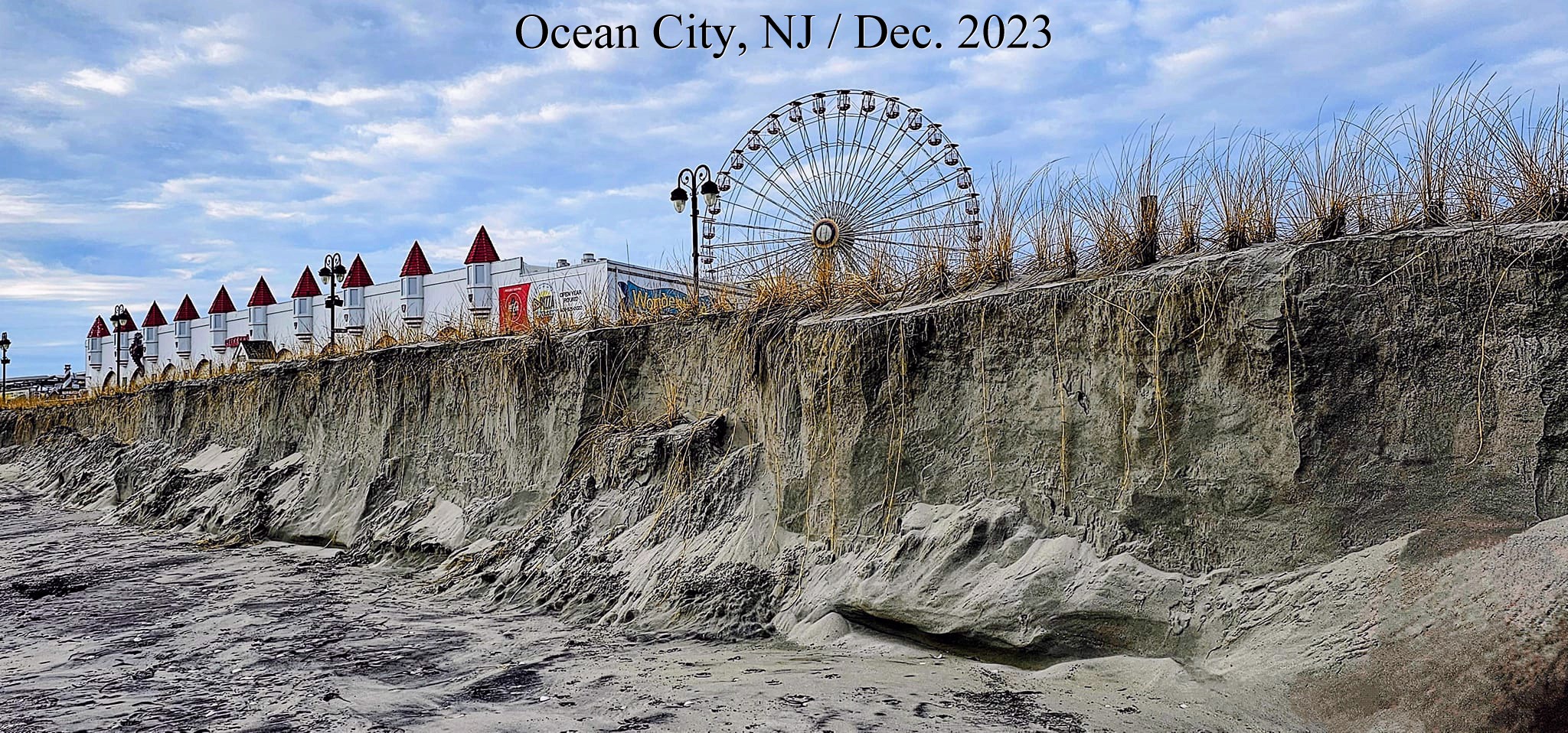
The momentum of rain and the turbulence of wind are part of a larger equation that includes not only the mass and velocity of precipitation but also the density. The combination of these variables results in an increased intensity of the flow dynamics. Ground without groundcover will be hit harder causing more damage. The groundcover will also be hit harder causing more damage. Concrete, asphalt, solar panels, roofs, and plants will sustain more damage. More hillsides and coastlines will collapse. Atmospheric rivers are causing unusual winter flooding in the Northeastern USA and beach erosion in Ocean City, NJ (pictured / December 2023). Stormwater systems are already becoming overwhelmed. Ironically, the streets of Abu Dhabi and Dubai, UAE, flooded days before the COP28 Climate Conference. Nowhere is safe from violent rain, not even in the desert preparing for a UN meeting on the climate crisis.
Eastern North America
The Eastern US is already seeing violent rain events as far inland as Kentucky with historic flooding in both 2022 and 2023. Eastern Canada has experienced its worst hurricanes on record. Florida, South Carolina, and North Carolina have suffered billions of dollars in storm damage. Homeowners insurance is becoming increasing difficult to obtain in Florida.
The Philadelphia Experiment
Philadelphia is 78 miles from the nearest coast; however, since 2021 Philadelphia has seen a multitude of violent rainstorms resulting in more precipitation than normally falls in an entire month falling in each episode. Besides being hit with Nor’easters and Southeastern tropical storms, Philadelphia is increasing getting deluges from the Gulf of Mexico.
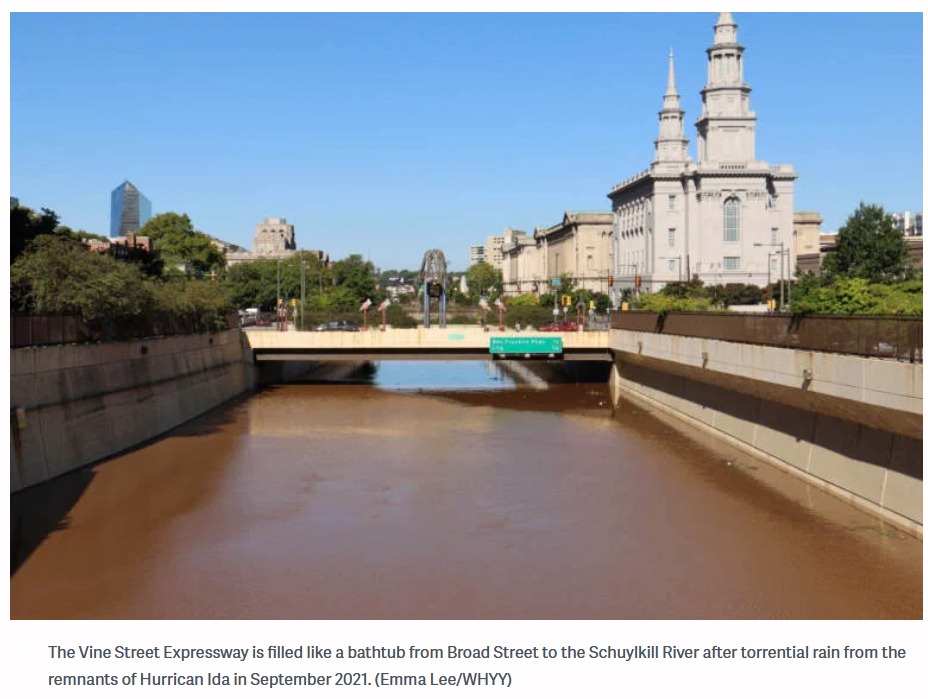
Hurricane Ida in the summer of 2021 is a good example. Because of the 85 degrees Fahrenheit Gulf of Mexico ocean temperature, Ida rapidly gained strength right before it made landfall jumping from a Category 1 to a Category 4 storm. The warm air allowed more moisture to be carried as rain. The storm was so large that it was able to pick up more moisture from the Atlantic Ocean. After destroying parts of Florida, the ocean moisture was carried inland and dumped over places like Pennsylvania and New York. Ida caused record flood damage in parts of Pennsylvania. The Philadelphia Inquirer reported, “The remnants of Hurricane Ida destroyed or damaged hundreds of homes in Southeastern Pennsylvania and caused more than $100 million in public infrastructure damage across the state.” There were more deaths in the Northeastern USA than where the storm made landfall in Louisiana. The New York Times reported, “The remnants of Hurricane Ida caused flash flooding and a number of deaths and disrupted transit across parts of New York and New Jersey. The storm killed at least 43 people in New York, New Jersey, Pennsylvania and Connecticut and left more than 150,000 homes without power.” Ida’s Philadelphia area destruction included 5 deaths, 7 tornadoes, record flooding, hundreds of water rescues, and “one incredibly soggy mess.” The violent rain in Philadelphia was so extreme that the main road across the city from the Delaware River to the Schuylkill River, the Vine Street Expressway, was turned into a canal. “You could’ve swam from 22nd Street to about 15th Street,” said Justin Galbreath, a district maintenance manager at the Pennsylvania Department of Transportation. As climate change intensifies, the frequency of Vine Street becoming a river will likely increase until such time as it becomes permanent.
The train derailment in Plymouth Meeting (July 17, 2023), the eleven vehicles swept away, and the seven people drowned by flood waters in Washington Crossing (July 15, 2023) were caused by a deluge of rain and flash flooding. “In my 44 years, I’ve never seen anything like it,” Upper Makefield Fire Chief Tim Brewer said. “When the water came up, it came up very swiftly. We do not think that anybody drove into it, that they were actively on that road when it happened.” CBS news reported, “Over 6 inches of rain in an hour caused the flash flooding according to Brewer. The fire department was dispatched in that area for a lightning strike and just by happenstance they found 11 cars. Eight people were rescued from the cars and two from the creek.”
In September of 2023, the Philadelphia Inquirer reported, “The remnants of Tropical Storm Ophelia soaked the entire Philadelphia region with episodic downpours on Saturday, the first day of fall, conspiring to incite 60-mph wind gusts at the Shore and high-tide flooding that closed numerous roads in beach and back-bay towns.” There were up to 8 inches of rain recorded throughout the Philadelphia region over the three day event.
East Coast Atmospheric Rivers
Historically in the United States, atmospheric rivers (AR) have been associated with the West Coast. Now, AR activity is getting more attention on the East Coast. “Actually, their frequency is not really increasing. Meteorologists have used the term for decades. It has simply become popular by the media. Just like polar vortex,” said Jeff Boyne, National Weather Service meteorologist and climatologist. Indeed, “atmospheric rivers are more frequent on the East Coast than they are on the West Coast,” said Jason Cordeira, associate professor of meteorology at Plymouth State University. “They’re just not as impactful and don’t usually produce as much rainfall.”
What is changing is the research into the types and increasing intensity of East Coast AR events. “Between 1958 and 2012, the Northeast saw more than a 70% increase in the amount of rainfall measured during heavy precipitation events, more than in any other region in the United States. Projections indicate continuing increases in precipitation, especially in winter and spring and in northern parts of the region,” as reported in The US Fourth National Climate Assessment.
Most types of East Coast ARs are increasing in intensity likely due to climate change. The study Identifying Eastern US Atmospheric River Types and Evaluating Historical Trends reports, “The impact of increasing moisture transport could be significant across the northeast corridor from Washington D.C. to Coastal Maine, as it increases the risk of extreme precipitation from landfalling ARs. The results indicate most ARs in the study domain are forced by extratropical cyclones, with lee side low pressure systems and coastal lows along the Atlantic Coast (e.g. nor’easters) responsible for producing the strongest ARs.”
How Fast Are Atmospheric Rivers Gaining Intensity?
Some areas of the world are now warming so fast, it is becoming more difficult to measure the change from “normal” or average. Jeff Boyne of the NWS said, “There are climate normals that are updated every 10 to 15 years, because the planet is warming so fast. The ENSO (El Nino-Southern Oscillation) regions are warming so fast that those normals are being updated every 5 years.” Overall, how fast is climate change accelerating? Rapidly. “It’s so far outside anything we’ve seen, it’s almost mind-blowing,” says Walter Meier, who monitors sea-ice with the National Snow and Ice Data Center. “September was, in my professional opinion as a climate scientist, absolutely gobsmackingly bananas,” said Zeke Hausfather, at the Berkeley Earth climate data project.”
— from The Reign of Violent Rain / Brouse and Mukherjee (2023)