bookmark_borderPennsylvania Climate Change: Lyme Disease, West Nile Virus, and Emerging Pathogens

by Daniel Brouse

Disease vectors are among the most critical–and often underestimated–risk factors of climate change. Together with deadly humid heat and increasingly violent rain events, these three threats drive an exponential rise in climate-related deaths. Disease vectors, such as mosquitoes and ticks, expand their range and transmission seasons as the climate warms, spreading infectious diseases to new regions and populations. Meanwhile, intensifying heatwaves push human bodies past their physiological limits, while extreme rainfall and flooding multiply health risks by spreading pathogens and destroying critical infrastructure. This deadly triad–disease, heat, and violent rain–underscores how climate change is not a distant threat but a present, accelerating driver of mortality worldwide.

One of the most concerning consequences of climate change is the surge in pathogen risks driven by rising temperatures, shifting precipitation patterns, and increased human displacement. Climate hazards directly fuel the migration of disease vectors (such as mosquitoes and ticks), expand pathogen survival zones, and increase the frequency of spillover events into human populations.

A landmark Nature study underscored the urgency of this threat:

“Over half of known human pathogenic diseases can be aggravated by climate change.”
Read the report (PDF)

Dr. Camilo Mora, lead author and associate professor at the University of Hawaii Manoa, explained:

“Climate hazards aggravated 58% of all known human pathogens. That is over half of infectious diseases discovered since the end of the Roman Empire.”

Pennsylvania Examples: Lyme Disease, West Nile Virus, and Emerging Pathogens

Climate change is fueling the spread of Lyme disease and other tick-borne illnesses in Pennsylvania, which consistently reports some of the nation’s highest Lyme disease case counts. Warmer winters and longer growing seasons are expanding the range and activity period of the blacklegged tick (Ixodes scapularis), allowing it to remain active later into fall and emerge earlier in spring. Increased humidity and shifting forest ecosystems support tick survival while altering the distribution of deer and rodent hosts necessary for their lifecycle.

These climate-driven shifts increase human exposure risk, leading to higher infection rates and adding strain to healthcare systems already burdened by climate-related health challenges. As warming accelerates, Lyme and other tick-borne diseases will continue to expand in range and intensity, underscoring the deeply interconnected risks between climate change and infectious disease dynamics.

Mosquitoes are far more than just a summertime nuisance — the insects are the world’s deadliest animal. Mosquitoes can spread disease when they bite, including West Nile Virus. In the first half of 2025, mosquitoes have tested positive for the virus in more than half of Pennsylvania’s 67 counties, according to the Pennsylvania Department of Environmental Protection, which has categorized the current West Nile Virus risk in the state as “high.” Warmer temperatures, wetter springs, and longer warm seasons allow mosquito populations to grow and persist, increasing the window for transmission and raising the risk of local outbreaks.

Beyond Lyme and West Nile, Pennsylvania is seeing climate-linked increases in other pathogens, including:

  • Babesiosis: A tick-borne parasitic infection increasingly detected in Pennsylvania, historically confined to New England, now spreading as ticks expand their range in warming conditions.
  • Powassan Virus: A rare but severe tick-borne illness showing increasing cases in the Northeast, including Pennsylvania, driven by warmer winters allowing tick populations to survive and spread.
  • Eastern Equine Encephalitis (EEE): Another mosquito-borne disease that can cause severe neurological symptoms and has seen increased activity in the region as warmer, wetter conditions improve mosquito breeding environments.
  • Flesh-eating Vibrio bacteria: While primarily coastal, warming waters and increased flooding can spread Vibrio vulnificus inland through waterways, posing emerging risks as climate conditions shift.

These examples illustrate how climate change is not a distant environmental issue but a current and escalating public health crisis in Pennsylvania. Warmer temperatures, shifting precipitation patterns, and ecological disruptions are amplifying the spread and severity of infectious diseases, increasing healthcare burdens while demanding urgent mitigation and adaptation strategies to protect public health.

Conclusion: Interconnected Crises Require Urgent Action

Economics, risk management, climate change, and pathogens are not isolated challenges–they form an interconnected crisis that will shape our collective future.

Climate change is not just an environmental issue; it is a public health emergency, an economic destabilizer, and a risk multiplier. The rising threat of pathogens, compounded by climate disruption, proves that adaptation alone will be insufficient.

Reducing greenhouse gas emissions remains the only systemic intervention capable of mitigating these cascading risks while preserving the foundations of health, stability, and equity in human societies.

Disease vectors, violent rain, and deadly humid heat are driving an exponential rise in climate-related deaths. This lethal triad–infectious disease, extreme heat, and intense rainfall–demonstrates that climate change is not a distant concern but a present, accelerating force behind rising mortality worldwide. Together, these threats magnify each other’s impacts, underscoring the urgent need to address climate change as a health crisis already unfolding.

* Our climate model — which incorporates complex social-ecological feedback loops within a dynamic, non-linear system — projects that global temperatures could rise by up to 9°C (16.2°F) within this century. This far exceeds earlier estimates of a 4°C rise over the next thousand years, signaling a dramatic acceleration of warming.

We analyze how human activities (such as deforestation, fossil fuel use, and land development) interact with ecological processes (including carbon cycling, water availability, and biodiversity loss) in ways that amplify one another. These interactions do not follow simple cause-and-effect patterns; instead, they create cascading, interconnected impacts that can rapidly accelerate system-wide change, sometimes abruptly. Understanding these dynamics is essential for assessing risks and designing effective climate adaptation and mitigation strategies.

What you can do today. How to save the planet.

Read: Solutions to the Fossil Fuel Economy and the Myths Accelerating Climate and Economic Collapse

Tipping points and feedback loops drive the acceleration of climate change. When one tipping point is breached and triggers others, the cascading collapse is known as the Domino Effect.

bookmark_borderViolent Rain Comes to the Philadelphia Area

by Daniel Brouse

Both the sea and air temperatures are rising. Warm air can hold more moisture than cool air. Warmer sea temperatures result in more evaporation. The increased moisture in the air moves over land causing inland deluges.

Violent Rain
Multiple factors figure into the physics of violent rain. The Momentum of Rain is p = mv (p = momentum, m = mass, v = velocity.) Part of the increasing momentum is transferred to the sides and upward increasing wind turbulence, as well as updrafts. Most of the momentum is transferred upon impact. You may notice the rain bouncing higher off the streets and sidewalks. As rain becomes more massive, it will have greater momentum when it hits the ground causing more damage.

Mass is not the only factor in violent rain. The greater the mass of the rain the more the wind turbulence is intensified. Professor Paul D. Williams of the University of Reading, UK, said, “They are chaotic (chaos theory). Turbulence is known famously as the hardest problem in physics.” In their study Evidence for Large Increases in Clear-Air Turbulence Over the Past Four Decades, Prof. Williams and his team found “Climate change has caused turbulence to double in the last 40 years” and is expected to double or triple again in the next decades.

Ocean City Beach Erosion

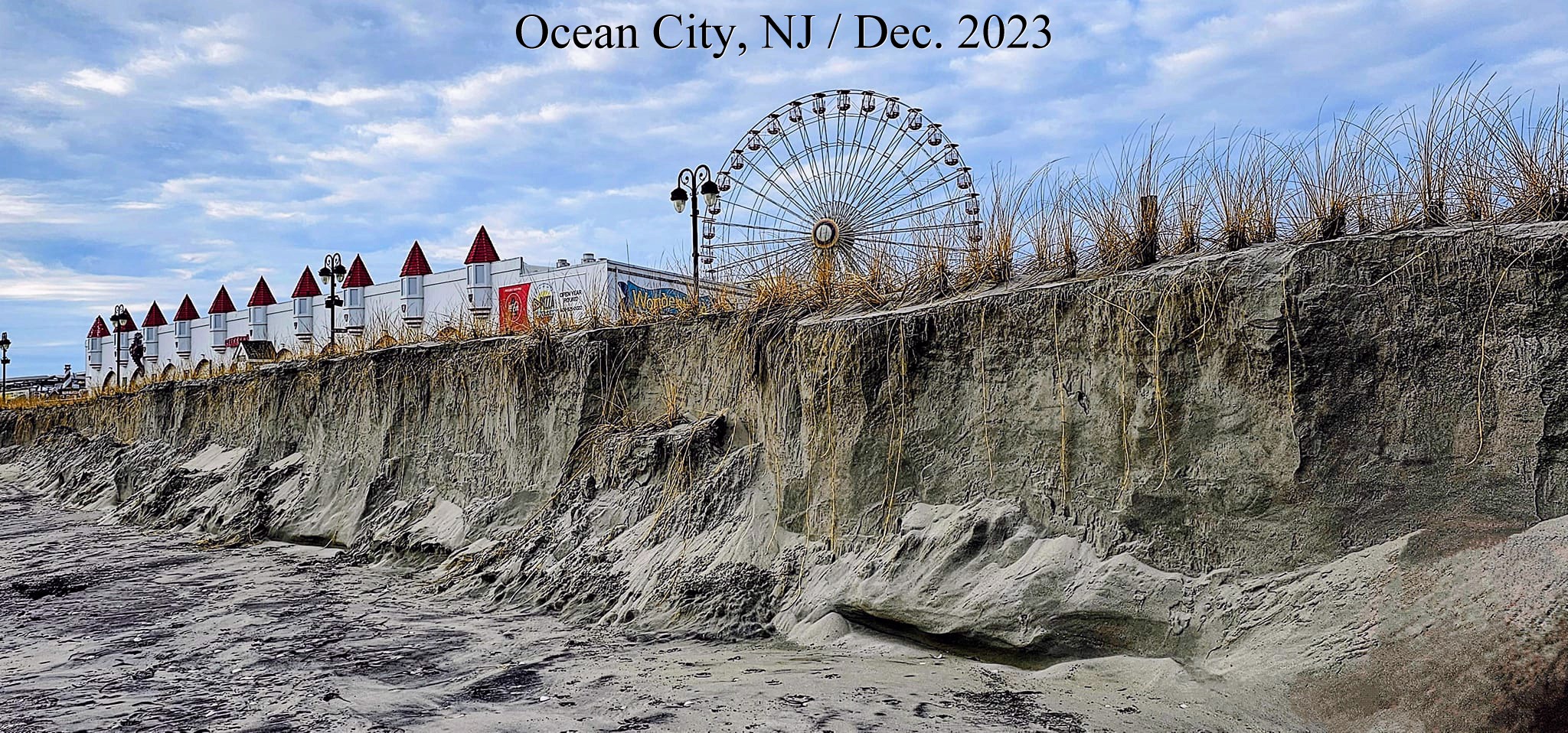
The momentum of rain and the turbulence of wind are part of a larger equation that includes not only the mass and velocity of precipitation but also the density. The combination of these variables results in an increased intensity of the flow dynamics. Ground without groundcover will be hit harder causing more damage. The groundcover will also be hit harder causing more damage. Concrete, asphalt, solar panels, roofs, and plants will sustain more damage. More hillsides and coastlines will collapse. Atmospheric rivers are causing unusual winter flooding in the Northeastern USA and beach erosion in Ocean City, NJ (pictured / December 2023). Stormwater systems are already becoming overwhelmed. Ironically, the streets of Abu Dhabi and Dubai, UAE, flooded days before the COP28 Climate Conference. Nowhere is safe from violent rain, not even in the desert preparing for a UN meeting on the climate crisis.

Eastern North America
The Eastern US is already seeing violent rain events as far inland as Kentucky with historic flooding in both 2022 and 2023. Eastern Canada has experienced its worst hurricanes on record. Florida, South Carolina, and North Carolina have suffered billions of dollars in storm damage. Homeowners insurance is becoming increasing difficult to obtain in Florida.

Vine Street Expressway Flooded

The Philadelphia Experiment
Philadelphia is 78 miles from the nearest coast; however, since 2021 Philadelphia has seen a multitude of violent rainstorms resulting in more precipitation than normally falls in an entire month falling in each episode. Besides being hit with Nor’easters and Southeastern tropical storms, Philadelphia is increasing getting deluges from the Gulf of Mexico.

Hurricane Ida in the summer of 2021 is a good example. Because of the 85 degrees Fahrenheit Gulf of Mexico ocean temperature, Ida rapidly gained strength right before it made landfall jumping from a Category 1 to a Category 4 storm. The warm air allowed more moisture to be carried as rain. The storm was so large that it was able to pick up more moisture from the Atlantic Ocean. After destroying parts of Florida, the ocean moisture was carried inland and dumped over places like Pennsylvania and New York. Ida caused record flood damage in parts of Pennsylvania. The Philadelphia Inquirer reported, “The remnants of Hurricane Ida destroyed or damaged hundreds of homes in Southeastern Pennsylvania and caused more than $100 million in public infrastructure damage across the state.” There were more deaths in the Northeastern USA than where the storm made landfall in Louisiana. The New York Times reported, “The remnants of Hurricane Ida caused flash flooding and a number of deaths and disrupted transit across parts of New York and New Jersey. The storm killed at least 43 people in New York, New Jersey, Pennsylvania and Connecticut and left more than 150,000 homes without power.” Ida’s Philadelphia area destruction included 5 deaths, 7 tornadoes, record flooding, hundreds of water rescues, and “one incredibly soggy mess.” The violent rain in Philadelphia was so extreme that the main road across the city from the Delaware River to the Schuylkill River, the Vine Street Expressway, was turned into a canal. “You could’ve swam from 22nd Street to about 15th Street,” said Justin Galbreath, a district maintenance manager at the Pennsylvania Department of Transportation. As climate change intensifies, the frequency of Vine Street becoming a river will likely increase until such time as it becomes permanent.

The train derailment in Plymouth Meeting (July 17, 2023), the eleven vehicles swept away, and the seven people drowned by flood waters in Washington Crossing (July 15, 2023) were caused by a deluge of rain and flash flooding. “In my 44 years, I’ve never seen anything like it,” Upper Makefield Fire Chief Tim Brewer said. “When the water came up, it came up very swiftly. We do not think that anybody drove into it, that they were actively on that road when it happened.” CBS news reported, “Over 6 inches of rain in an hour caused the flash flooding according to Brewer. The fire department was dispatched in that area for a lightning strike and just by happenstance they found 11 cars. Eight people were rescued from the cars and two from the creek.”

In September of 2023, the Philadelphia Inquirer reported, “The remnants of Tropical Storm Ophelia soaked the entire Philadelphia region with episodic downpours on Saturday, the first day of fall, conspiring to incite 60-mph wind gusts at the Shore and high-tide flooding that closed numerous roads in beach and back-bay towns.” There were up to 8 inches of rain recorded throughout the Philadelphia region over the three day event.

East Coast Atmospheric Rivers
Historically in the United States, atmospheric rivers (AR) have been associated with the West Coast. Now, AR activity is getting more attention on the East Coast. “Actually, their frequency is not really increasing. Meteorologists have used the term for decades. It has simply become popular by the media. Just like polar vortex,” said Jeff Boyne, National Weather Service meteorologist and climatologist. Indeed, “atmospheric rivers are more frequent on the East Coast than they are on the West Coast,” said Jason Cordeira, associate professor of meteorology at Plymouth State University. “They’re just not as impactful and don’t usually produce as much rainfall.”

What is changing is the research into the types and increasing intensity of East Coast AR events. “Between 1958 and 2012, the Northeast saw more than a 70% increase in the amount of rainfall measured during heavy precipitation events, more than in any other region in the United States. Projections indicate continuing increases in precipitation, especially in winter and spring and in northern parts of the region,” as reported in The US Fourth National Climate Assessment.

Most types of East Coast ARs are increasing in intensity likely due to climate change. The study Identifying Eastern US Atmospheric River Types and Evaluating Historical Trends reports, “The impact of increasing moisture transport could be significant across the northeast corridor from Washington D.C. to Coastal Maine, as it increases the risk of extreme precipitation from landfalling ARs. The results indicate most ARs in the study domain are forced by extratropical cyclones, with lee side low pressure systems and coastal lows along the Atlantic Coast (e.g. nor’easters) responsible for producing the strongest ARs.”

How Fast Are Atmospheric Rivers Gaining Intensity?
Some areas of the world are now warming so fast, it is becoming more difficult to measure the change from “normal” or average. Jeff Boyne of the NWS said, “There are climate normals that are updated every 10 to 15 years, because the planet is warming so fast. The ENSO (El Nino-Southern Oscillation) regions are warming so fast that those normals are being updated every 5 years.” Overall, how fast is climate change accelerating? Rapidly. “It’s so far outside anything we’ve seen, it’s almost mind-blowing,” says Walter Meier, who monitors sea-ice with the National Snow and Ice Data Center. “September was, in my professional opinion as a climate scientist, absolutely gobsmackingly bananas,” said Zeke Hausfather, at the Berkeley Earth climate data project.”

— from The Reign of Violent Rain / Brouse and Mukherjee (2023)

bookmark_borderExcyte Entertainment Wedding DJ Fraud

Dan Leidy, owner of Excyte Entertainment in Hatfield, PA, is accused of fraudulently using email addresses to vote for himself in online popularity polls. In January of 2022, Excyte Entertainment voted for themselves as “best wedding DJ” using an unauthorized email address. A victim of the fraud contacted Excyte Entertainment but received no response.

The site Montco Happening runs a contest for their “Happening List”.
Poll: Wedding: DJ
Vote: Excyte Entertainment (Hatfield) — http://www.excyteentertainmentpa.com/

HappeningsMedia.com did not respond to a request for comment.

Update:
Excyte Entertainment responded to our Google review.

Kind of funny you aren’t even using your real Name, unsure what you are talking about or how We would even Get your email as we have no previous clients named King Arthur, Are you sure you aren’t another Dj whom can not win said contest so you have to resort to this .Good Luck this year .

Our reply:
King Arthur is the real name of our company. No, we are not wedding DJ’s. One of the things we do is represent artists’ Intellectual Property Rights, of which you have violated ours. Your response is shameful and requires further action on our part.

Excyte Entertainment Website