bookmark_borderPSA: Wildfire Smoke Hazards

🚨 DON’T LET THE SUN FOOL YOU. ☀️🔥

When wildfire smoke fills the air, those brief moments of sunshine can actually make the air MORE dangerous.

Ground-level ozone is one of the most harmful air pollutants. It damages the lungs, worsens heart and respiratory disease, and contributes to millions of premature deaths each year. Avoid exposure.

☀️ UV sunlight reacts with pollutants in wildfire smoke to create ground-level ozone—an invisible, highly toxic gas that damages your lungs, worsens heart and respiratory disease, and contributes to millions of premature deaths worldwide.

⚠️ If you can smell smoke or see haze:
• Limit outdoor activity—even if the sky looks brighter.
• Check your local Air Quality Index (AQI).
• Keep indoor air clean with HEPA and activated carbon filtration.
• Protect children, older adults, and anyone with asthma, COPD, or heart disease.

Smoke may fade. Ozone doesn’t become any less dangerous because you can see the sun.

#WildfireSmoke #AirQuality #Ozone #PublicHealth #ClimateChange #StaySafe #AQI

Important Reminder: Wildfire Smoke

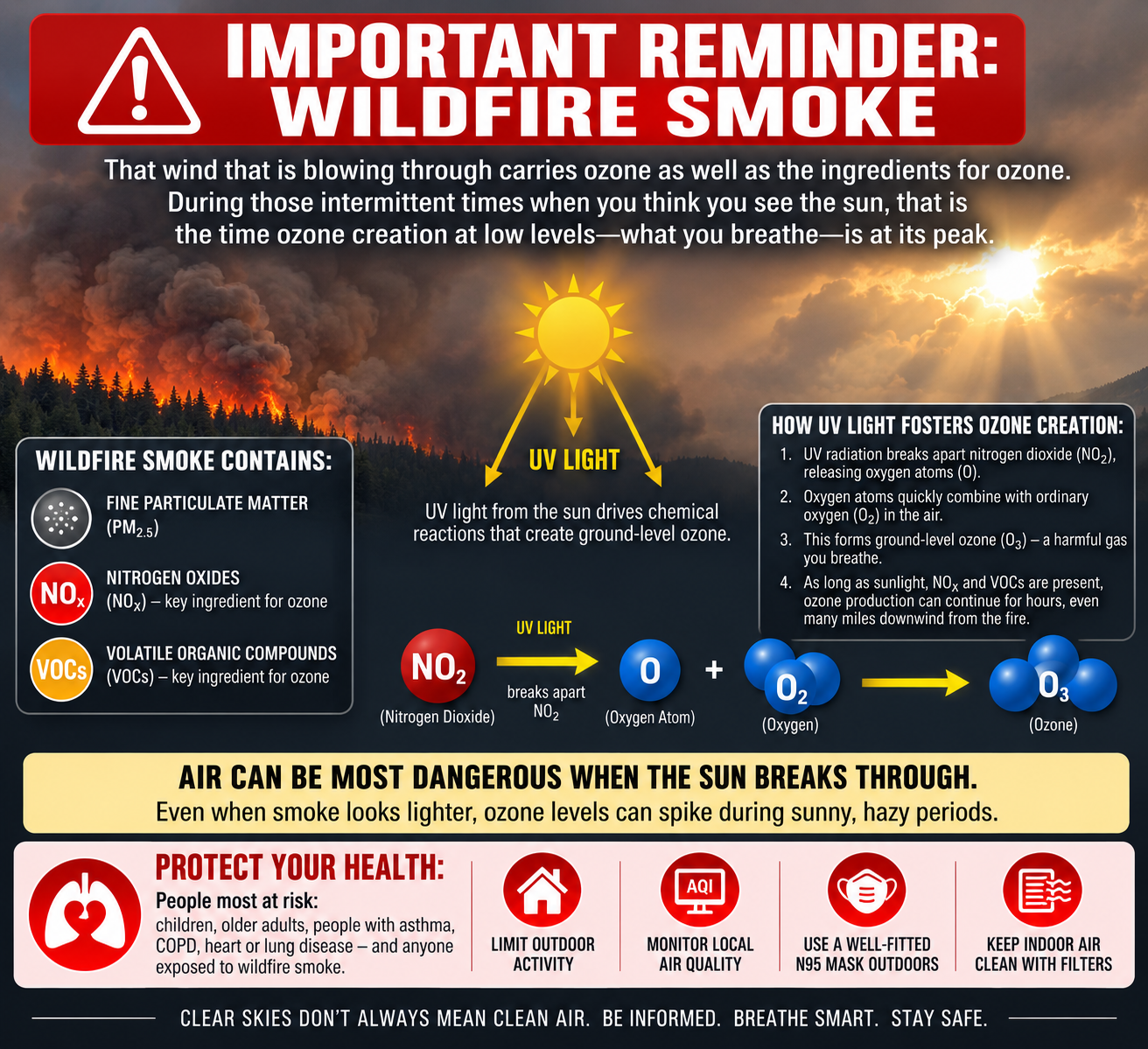
Wildfire smoke carries far more than fine particulate matter (PM₂.₅). It also contains ozone (O₃) and the chemical precursors that create ozone, including nitrogen oxides (NOₓ) and volatile organic compounds (VOCs). When the smoke thins enough for sunlight to break through—even if the sky still appears hazy—ultraviolet (UV) radiation rapidly accelerates the chemical reactions that produce ground-level ozone.

This means that those intermittent periods when you briefly see the sun can coincide with the highest ozone concentrations near the ground—the air you breathe. UV light acts as the energy source that breaks apart nitrogen dioxide (NO₂), releasing oxygen atoms that quickly combine with ordinary oxygen (O₂) to form ozone (O₃). As long as sunlight, NOₓ, and VOCs are present, ozone production can continue for hours, even many miles downwind from the fire.

As a result, air quality can remain hazardous even when the smoke appears lighter or less visible. For sensitive individuals—including children, older adults, people with asthma or COPD, and anyone with heart or lung disease—these sunny breaks can actually represent one of the most dangerous times to be outdoors. Whenever wildfire smoke is present, continue to monitor local air quality and limit outdoor activity until both particulate pollution and ozone levels have returned to safe ranges.
bookmark_borderPhiladelphia Heatwave, 900% Electricity Spike, and Rising Grid Stress in a Warming Climate

The current heatwave affecting Philadelphia and the surrounding Mid-Atlantic region is unfolding within the broader context of ongoing global warming, where rising average temperatures are increasing both the frequency and severity of extreme heat events.

In Philadelphia, as in many urban areas, the warming baseline amplifies heat extremes. Higher daytime temperatures, reduced nighttime cooling, and elevated humidity increase thermal stress on residents, infrastructure, and energy systems. Urban heat island effects can further intensify these conditions, making heatwaves more dangerous and persistent in densely built environments like Philadelphia.

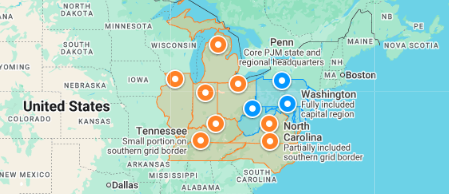
These conditions place significant strain on the regional electric grid. Philadelphia is part of the PJM Interconnection, which serves more than 65 million people across the Mid-Atlantic, including Pennsylvania, New Jersey, Maryland, and surrounding states.

During the current heatwave, PJM capacity markets have reflected this stress. The July 2, 2026 capacity pricing event saw a sharp spike in electricity capacity costs—payments utilities make to ensure enough generation is available to meet demand during peak periods.

Capacity prices surged from approximately $28 per megawatt-day to around $270 per megawatt-day in some regions, representing an increase of nearly 900%. In constrained subregions, prices rose even higher, exceeding $400–$460 per megawatt-day.

These price spikes reflect the cost of maintaining grid reliability during extreme conditions—particularly during heatwaves when electricity demand in Philadelphia and the broader region surges due to widespread air conditioning use.

As temperatures rise, cooling demand increases sharply across Philadelphia and the surrounding metro area. This produces cascading stress across the power system:

  • sharply higher electricity demand during peak heat events
  • increased strain on generation and transmission infrastructure
  • elevated water demand in some regions for cooling and thermal plant operations
  • higher emissions during peak load periods in fossil-reliant portions of the grid

This creates a reinforcing sequence:

more heat → more cooling demand → higher electricity demand → increased emissions (in fossil-dependent systems) → further warming → more heat

In practice, what emerges is not a single isolated feedback loop, but a coupled network of reinforcing pressures affecting both the physical climate system and human infrastructure systems in and around Philadelphia.

These interactions can become increasingly nonlinear under sustained warming and repeated extreme heat events.

The key point is that these dynamics are already present, but their magnitude and impact are especially visible in urban and high-demand regions like Philadelphia, where heat exposure, electricity demand, and grid constraints converge. Reducing risk ultimately depends on rapidly reducing greenhouse gas emissions while adapting energy infrastructure to rising heat extremes and increasing peak demand stress.

bookmark_borderPlymouth Meeting: the Cradle of the Climate Crisis

by Daniel Brouse
July 29, 2023

The train derailment in Plymouth Meeting (July 17, 2023) and the seven people swept away by flood waters in Washington’s Crossing (July 15, 2023) were caused in part by our forefathers’ creation and contribution to climate change. In the 1600’s and 1700’s, the United States fostered worldwide freedom, abolition, revolution, war, finance, commerce, and industry. In 1688, the American forefathers created the cradle of human induced global warming in Plymouth Meeting, PA with the establishment of a limestone quarry and limekilns.

Limekilns are used to make quicklime by cooking limestone to 1,650 ℉. Quicklime is used in fertilizer, insecticides, tanning, mortar, plaster, high-grade steel, paper, and cement. Until the creation of the limekilns in 1688, colonists crushed oyster shells to create quicklime. The quicklime industry helped fund the American Revolution and the Underground Railroad.

Decomposing limestone (CaCO3) into quicklime (burnt limestone; CaO) releases significant CO2 emissions, both from the combustion of fuel needed to heat the kiln to temperatures over 1,000°C, and by the release of CO2 from the reaction itself (CaCO3 –> CaO + CO2). Because quicklime is a key ingredient in the production of cement, as well as being used in steel, pulp-and-paper and other industries, efforts are underway to reduce the carbon footprint of this operation. — Chemical Engineering / February 1, 2022

Plymouth Meeting

Plymouth Friends Meetinghouse: birthplace of the American Revolution
The Quaker Meetinghouse (located at the corners of Butler Pike and Germantown Avenue) is where the forefathers met to plan and carry out the creation of the USA.

Across the street…
The Underground Railroad: birthplace of Freedom in the USA
“As part of the Plymouth Meeting Anti-Slavery Society they held meetings in the Plymouth Friends Meetinghouse across the street from their home.”

Head north just a bit…
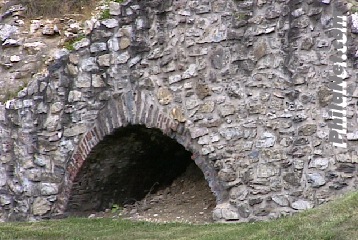
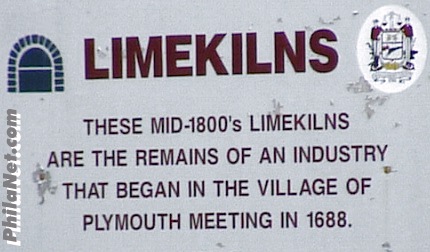
Limekilns: The cradle of commerce in the USA
“Remains of an industry that began in the village of Plymouth Meeting in 1688”
The original Made in America human influencer of climate change on an industrial scale.

If you head east a bit…
Old Corson Quarry: original mine for the limekilns and site of the train derailment
Before they discovered limestone in Plymouth Meeting, colonists had to crush oyster shells. The quarry is still in use today and was purchased by Highway Materials, Inc. in 1997.

Conclusion

On a weekend in July 2023, extreme rainfall caused flash flooding that resulted in:

  • seven drowning fatalities in Washington’s Crossing, PA
  • sinkholes to develop in the carbonate rock under the railroad tracks in Plymouth Meeting causing a train derailment

The deaths and damage to infrastructure were caused in part by the culture, economics, and “cradle of climate change” created in Plymouth Meeting in 1688.

LimekilnLimekiln Sign in Plymouth Meeting

The Human Induced Climate Change Experiment

©The Philadelphia Spirit Experiment Publishing Company
These graphics, images, text copy, sights or sounds may not be used without our expressed written consent.