bookmark_borderWest Chester University New Planetarium

WEST CHESTER, PA — Students enrolled in the Department of Geology and Astronomy are now actually able to visualize what takes place below the Earth’s surface during events such as an earthquake or volcano, and what may have occurred billions of years ago in space.

This past summer, the University replaced its 44-year-old system of gears and mirrors with a 32-foot nanoseam dome and powerful digital planetarium projector, designed specifically for “full dome” education. Built by Spitz, the world leader in projection domes, and powered by “Starry Night” and “The Layered Earth,” the SciDome XD Touch system provides real time simulation for space and earth science teaching. Students can explore the layers of Earth in 3D detail, or immerse themselves in an interactive visual universe.

“In place of sky views seen only from the Earth, the new system allows students to look beyond the solar system and study star formations or clusters of galaxies and galactic mergers beyond our own Milky Way from any prospective,” says Karen Vandlandingham, associate professor and director of the planetarium.

“Students have the capability of standing on Mars, for example, and of having a view as if they’re next to the rover that was left there.”

“Geology students are taking advantage of this equipment as well,” says Vanlandingham. “The ‘Layered Earth’ program can project huge areas of the Earth onto the dome. Any data base of earthquakes, for example, can be projected – even the center of a quake. Students can also observe what’s happening under the Earth’s surface as a volcano develops.”

Located in the Schmucker Science Center link, the new facility is named after alumna and retired faculty member Dr. Sandra F. Pritchard Mather. In addition to enhancing the educational experience of WCU students, the new planetarium is expected to continue being an exceptional resource for the surrounding community. Each year, thousands of children, local community groups and individuals attend its weekly private presentations and hour-long monthly evening shows – all which begin again on October 18.
bookmark_borderLove Park

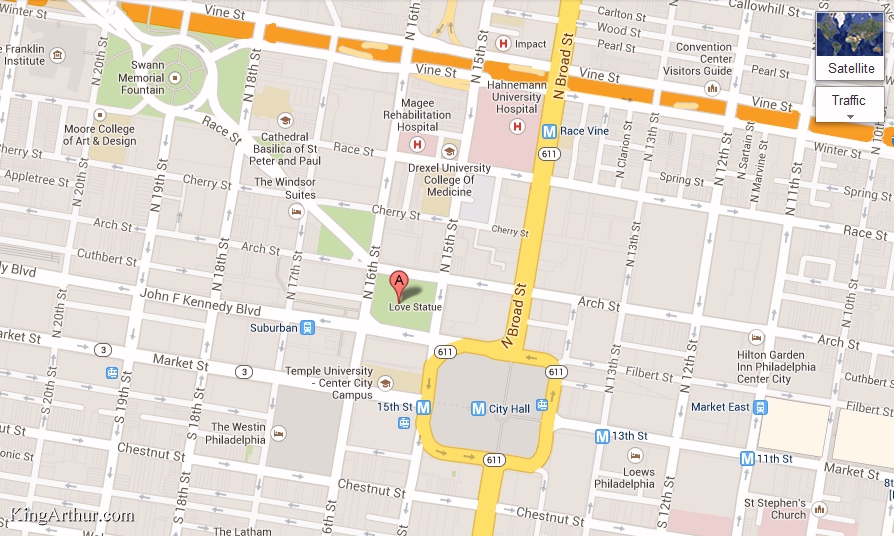
Map of Love Park, Philadelphia, PA

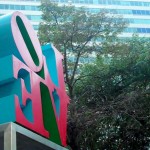
Love Park is the name locals have given to John F. Kennedy Plaza in center city Philadelphia. The famous Love sculpture was made by Robert Indiana. It “was first placed in the plaza in 1976 as part of the United States’ Bicentennial celebration. It was removed in 1978, but the sculpture was missed and the chairman of Philadelphia Art Commission, F. Eugene Dixon, Jr., bought the sculpture and permanently placed it in the plaza, in 1978.”

The park is open to the public and free to visit.

bookmark_borderPhiladelphia Air Quality and Weather

Although Philadelphia is located less than 100 miles from the Atlantic Ocean, its climate is predominantly influenced by air masses and prevailing winds from an inland direction. The weather is highly variable, characterized by a succession of alternate high and low pressure systems moving, in general, from west to east with average velocities of 30 to 35 miles per hour (mph) in winter and 20 to 25 mph in summer.

The normal paths of practically all low pressure systems affecting weather in the United States are toward the northeast corner of the nation. About 40 percent of the low centers pass very close to Philadelphia and most of the others approach closely enough to exert some influence on Philadelphia weather, resulting in a regular change in weather patterns without any consistent periods of stagnation. The movement of high pressure centers is slowest in summer and early fall and, because the lower edge of the prevailing westerlies aloft is farthest north at the same time, high pressure centers sometimes become stationary for periods of several days near the Philadelphia area. The result is increasing atmospheric stability at such times. This condition is frequently broken up diurnally in the summer because of the length and intensity of the sun’s heating during the day, but strongly stable conditions may persist for a number of successive days in almost any month. Persistent stability, lasting ten days or more, occurs infrequently: on the average, perhaps once in ten years, but it may possibly happen in successive years or more than once in the same year.

Stagnating high pressure systems which result in winds of less than seven mph for a period of seven or more days occurs seldomly. Stagnation lasting four or more days occurred much more frequently and reached a maximum in fall.

During the spring, fall and winter, the weather is dominated by cold air masses of the continental Arctic or continental polar types. These air masses are extremely stable at their source, but are subjected to heating from below as they move across the land, thus generally becoming unstable in the lower few thousand feet by the time they reach Philadelphia. In the summer, the maritime tropical air mass plays as great a part in the weather as the continental air masses. Nocturnal cooling from below produces a high frequency of temperature inversions during the summer, but these are most often broken up or weakened by heating during the day, with ensuing turbulence and mixing at the atmosphere.

Philadelphia is located on the Atlantic Coastal Plain, some 50 miles or more from the nearest mountains (Appalachian) and large bodies of water (Atlantic Ocean and Delaware Bay). The land and sea breeze effect is practically never felt at Philadelphia and the mountain-valley circulation is non-existent.

Within the City itself there are very few marked extremes in topography. Elevations range from sea level at the southern and southwestern extremities of the City to 400 to 450 feet above sea level in the northwestern section (Chestnut Hill), about ten miles away. The Wissahickon Creek and the Schuylkill River flow through the north western part of the City, however, and along these two streams there are some rather sharp rises in elevation, as much as 100 to 200 feet in a horizontal distance of 500 feet. Such extremes are quite limited and would not influence the meteorological patterns which affect the City as a whole. They could, of course, contribute to 2013 – 2014 AMNP increased air pollution problems in a small local area within the City under certain circumstances.

In general, the topography of the City and the immediate surrounding area is such that it would make no significant contribution to increased air stagnation and stability over and above that produced by the meteorological pattern.