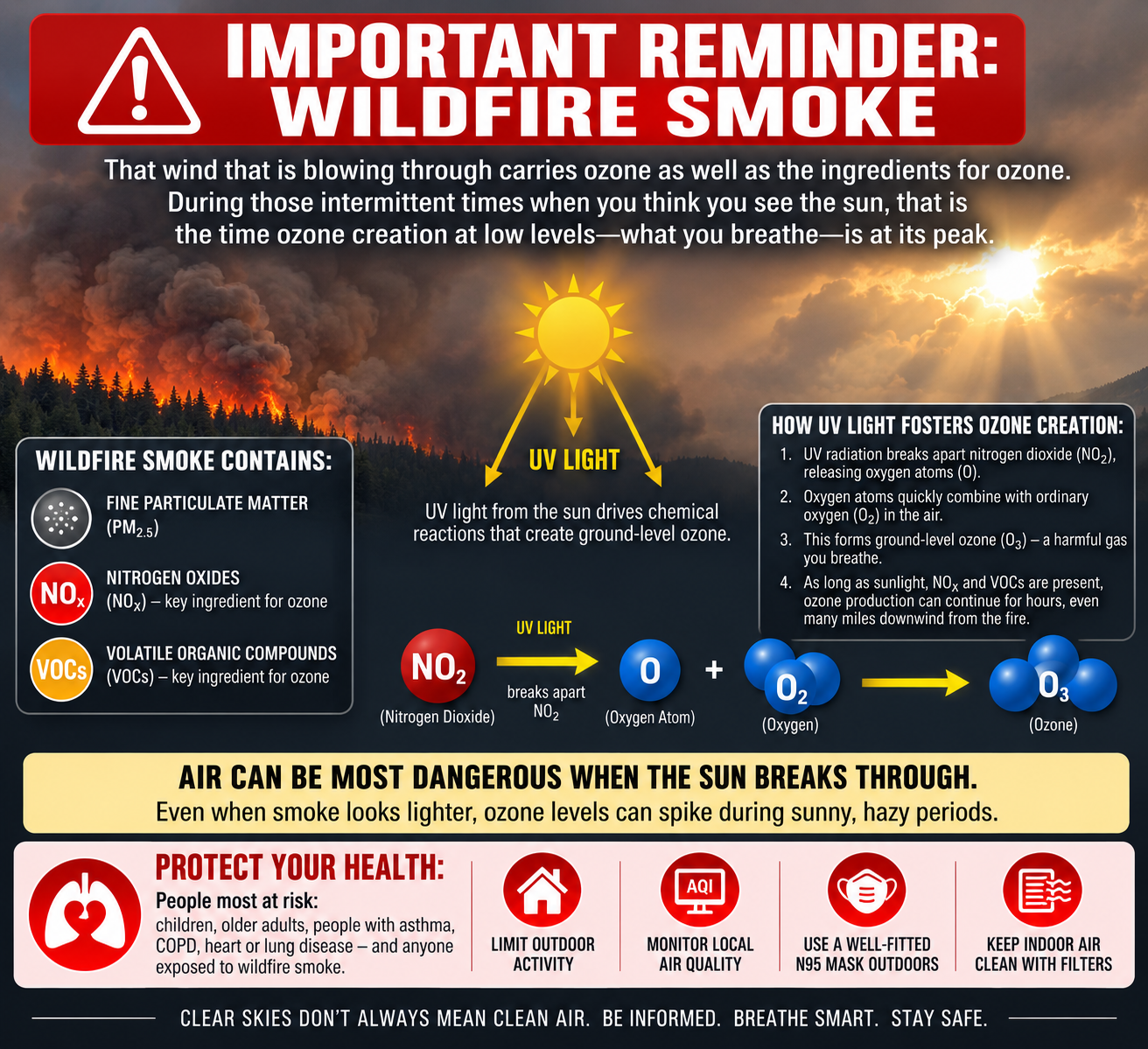
🚨 DON’T LET THE SUN FOOL YOU. ☀️🔥
When wildfire smoke fills the air, those brief moments of sunshine can actually make the air MORE dangerous.
Ground-level ozone is one of the most harmful air pollutants. It damages the lungs, worsens heart and respiratory disease, and contributes to millions of premature deaths each year. Avoid exposure.
☀️ UV sunlight reacts with pollutants in wildfire smoke to create ground-level ozone—an invisible, highly toxic gas that damages your lungs, worsens heart and respiratory disease, and contributes to millions of premature deaths worldwide.
⚠️ If you can smell smoke or see haze:
• Limit outdoor activity—even if the sky looks brighter.
• Check your local Air Quality Index (AQI).
• Keep indoor air clean with HEPA and activated carbon filtration.
• Protect children, older adults, and anyone with asthma, COPD, or heart disease.
Smoke may fade. Ozone doesn’t become any less dangerous because you can see the sun.
#WildfireSmoke #AirQuality #Ozone #PublicHealth #ClimateChange #StaySafe #AQI
Important Reminder: Wildfire Smoke
Wildfire smoke carries far more than fine particulate matter (PM₂.₅). It also contains ozone (O₃) and the chemical precursors that create ozone, including nitrogen oxides (NOₓ) and volatile organic compounds (VOCs). When the smoke thins enough for sunlight to break through—even if the sky still appears hazy—ultraviolet (UV) radiation rapidly accelerates the chemical reactions that produce ground-level ozone.
This means that those intermittent periods when you briefly see the sun can coincide with the highest ozone concentrations near the ground—the air you breathe. UV light acts as the energy source that breaks apart nitrogen dioxide (NO₂), releasing oxygen atoms that quickly combine with ordinary oxygen (O₂) to form ozone (O₃). As long as sunlight, NOₓ, and VOCs are present, ozone production can continue for hours, even many miles downwind from the fire.
As a result, air quality can remain hazardous even when the smoke appears lighter or less visible. For sensitive individuals—including children, older adults, people with asthma or COPD, and anyone with heart or lung disease—these sunny breaks can actually represent one of the most dangerous times to be outdoors. Whenever wildfire smoke is present, continue to monitor local air quality and limit outdoor activity until both particulate pollution and ozone levels have returned to safe ranges.